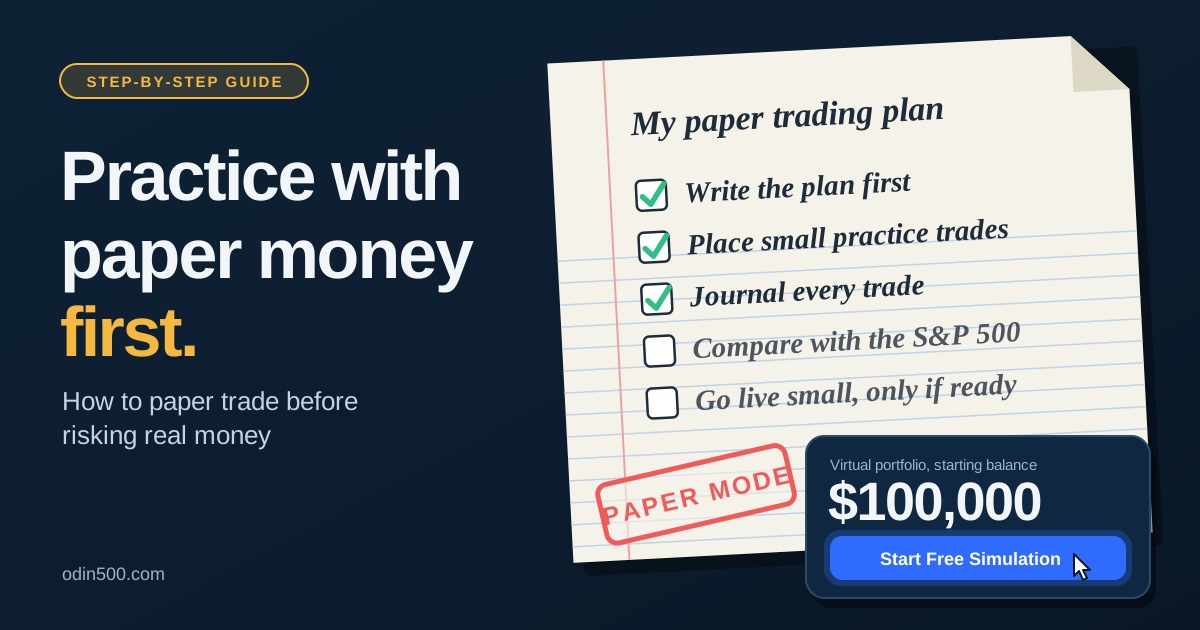
Most new investors learn the same lesson the expensive way: the first few real trades teach you far more about your own habits than about the market. You hold a loser too long, buy something because it jumped, or put too much into one idea. Each mistake costs real money.
Paper trading lets you make those mistakes for free. You trade with virtual money at real market prices, track the results and learn what works before a single dollar is at risk. This guide walks through exactly how to do it, in seven steps, and explains what paper trading can't teach you.
What Is Paper Trading?
Paper trading means buying and selling stocks in a simulator using pretend money, while the prices come from the real market. The name comes from writing practice trades on paper. A modern simulator tracks your positions, cash and performance automatically.
It's good for learning how orders and portfolios work, testing a strategy and building a routine. It isn't a perfect copy of real trading, and we'll get to the gaps below. Think of it as flight training: you learn the controls without the crash risk.
Step 1: Choose a Simulator That Fits
A good simulator uses real prices, tracks your portfolio honestly and lets you compare your results with something. Odin500's free paper trading simulator starts you with a virtual portfolio of $100,000, shows performance charts for your results, and lets you compare your portfolio with live AI-managed portfolios from Claude, ChatGPT, Gemini and Grok. Sign up for free and open the virtual portfolio to start.
One tip on the starting balance: scale it to your real life. If you plan to invest $5,000 and would put at most 20% in one stock, that's $1,000 per position. On a $100,000 paper account, the equivalent is $1,000 as well, which is only 1% of the account. Size your practice trades to match the real amounts you expect to use, not the big number on the screen.
Step 2: Write a Trading Plan Before Your First Trade
Random paper trades teach very little. A plan gives you something to test. Write down these six things before you buy anything:
Plan element | Example |
|---|---|
Universe | S&P 500 stocks only |
Maximum positions | 5 |
Position size | Up to 20% of the account each |
Entry rule | Only stocks on my watchlist, each with a written reason |
Exit rule | A price or a reason to sell, written before I buy |
Review schedule | Every week |
This isn't just a beginner idea. Every AI portfolio on Odin500 runs a fixed plan like this: an index universe, a direction, a number of positions and a rebalance schedule. Most hold five positions. You can see how those plans play out on the AI portfolio leaderboard and borrow the structure for your own.
Step 3: Find Ideas the Way You Would With Real Money
Don't paper trade on impulse. Use the same research habits you want to keep when real money is on the line. The heatmap shows which sectors are leading, the market movers page surfaces stocks in the news, and each stock's ticker page has an OHLC chart and return summaries. Add candidates to a watchlist first, write down why each one is there, and only then consider a trade.
Step 4: Place Small Trades and Keep a Journal
Start with a handful of small positions rather than your full allocation. For every trade, write a short entry in a journal:
The stock and the reason. One sentence on why you're buying.
Your entry price. What you paid.
Your exit plan. The price or event that would make you sell.
The result. What happened, once the trade is closed.
The lesson. What you'd do differently.
The journal is the most valuable part of the exercise. A paper account that shows +8% teaches you little. A journal that shows you sold winners early three times in a row teaches you something you can fix.
Step 5: Treat It Like Real Money
Paper trading only works if you follow the same rules you'd follow with real cash. That means a few commitments:
No do-overs. Don't reset the account after a bad stretch. A losing streak is the lesson.
Stick to your position sizes. Don't put half the account in one stock just because there's no real downside.
Follow your exit rules. If your plan says sell, sell.
Account for costs. Real trades involve fees and imperfect prices, so subtract a small cushion from your results when you review them.
Step 6: Measure Yourself Against a Benchmark
Making money isn't the right test. The right test is whether you beat a simple alternative. Over a short window, even the market can lose money. In a sample snapshot of Odin500's returns table, the S&P 500 shows about -5.5% over one month, +0.5% over six months and +9.8% over one year. A paper portfolio that gained 3% in a month where the market fell 5.5% did well. One that gained 3% when the market gained 8% did not.
Compare your portfolio with the S&P 500, and with the AI portfolios on the compare page. Odin500 also has a relative performance section for checking individual stocks against a benchmark.
Step 7: Decide When You're Ready to Go Live
Guides disagree on how long to paper trade. Suggestions range from two to four weeks just to learn a platform, to one to three months or 50 to 100 trades to test a strategy, to as much as six months. A better yardstick than the calendar is evidence:
You've made enough trades to see a pattern, ideally across both rising and falling markets.
You followed your plan on almost every trade.
Your results compare reasonably with the benchmark over several months.
You can explain why your winners won and your losers lost.
When you do go live, start with small positions and keep the paper account running in parallel. Your first real trades should be about checking that your process survives real emotions, not about making money.
What Paper Trading Can't Teach You
Emotions. A 10% paper loss is a data point. A 10% real loss makes people sell at the bottom or freeze. This is the biggest gap, and no simulator can close it.
Execution. Simulated fills are usually cleaner than real ones. Real orders can suffer slippage, partial fills and wide spreads, especially in thinly traded stocks or fast markets. Odin500's simulation prices fills against daily closing data and says plainly that simulated fills may differ from live brokerage execution.
Market impact. Your practice orders don't move prices. Large real orders can.
Overconfidence. A strong run on paper can make you bolder than your real skill justifies.
That's why the last step is a small real-money test, not a leap.
Common Mistakes to Avoid
Treating it like a game. Reckless practice builds reckless habits.
Skipping the plan. Without rules, you can't tell luck from skill.
Judging by one good week. Short windows are mostly noise.
Quitting too early or never moving on. Some people leave after one win, others practice forever. Set criteria in advance.
Key Takeaways
Paper trading lets you practice with real prices and no financial risk.
Write a plan, keep a journal and treat the account like real money.
Judge results against a benchmark, not against zero.
Decide when to go live based on evidence, not the calendar.
Paper trading can't teach emotions, so start small when you go live.
Frequently Asked Questions
What is paper trading?
Paper trading is practicing stock trades with virtual money at real market prices. It lets you learn how orders, portfolios and strategies work without risking your own cash.
Is there a free paper trading simulator?
Yes. Odin500's free plan includes a $100,000 virtual portfolio, performance charts and the ability to compare your results with live AI-managed portfolios.
How long should I paper trade before using real money?
There's no single answer, and guides suggest anywhere from a few weeks to several months. Focus on having enough trades to see a pattern, following your plan consistently and comparing well with a benchmark over several months.
Does paper trading prepare you for real trading?
It prepares you for the mechanics, such as placing orders, sizing positions and tracking results. It doesn't prepare you for the emotions or the execution quirks of real markets, so start with small positions when you go live.
This article is for educational purposes only and is not investment advice. Paper trading results are simulated and do not guarantee real-money results.