Most watchlists start the same way. You add a few stocks you like, a few you heard about, and one you meant to research last month. A few weeks later the list has fifty tickers, nobody remembers why half of them are there, and you check it mostly out of habit. That isn't a watchlist. It's a pile.
A stock watchlist that works does one thing: it helps you notice what matters in time to act on it. This guide shows you how to build a stock watchlist in six steps, with real sector data to show why structure matters.
Quick answer: Split your tickers into lists with one job each, keep each list to 10 to 20 names, cover several sectors, write a reason and a trigger for every stock, and review the whole thing once a week.
Why most watchlists fail
Three problems show up again and again. The list has no purpose, so every stock gets the same attention. It has no coverage, so it quietly follows one theme. And it has no review, so stale names pile up and the useful ones get buried.
The fix isn't a better app. It's a few rules about what earns a spot.
The six-step framework
1. Give each list one job
Split your tickers into separate lists, each with a clear purpose:
Research. Ideas you don't understand yet. The goal is to learn, not to trade.
Monitor. Stocks you own or plan to own soon. The goal is to track what could change your view.
Ready. Names you'd buy at a specific price or setup. The goal is to act when the trigger hits.
A stock should move between lists as your thinking develops, and it should never sit in two at once.
2. Keep it small enough to know
There's no magic number, but a practical rule is this: if you can't explain in one sentence why a stock is on your list, it doesn't belong. For most people that means 10 to 20 names per list. A short list gets checked. A long one gets ignored.
3. Cover the map, not just your favorites
Most beginners watch the sectors they already follow, usually technology. Here is how differently sectors can behave, from Odin500's market dashboard at the latest daily close at the time of writing.
Group | 1 month | 1 year |
|---|---|---|
Technology | -12.2% | +20.1% |
Healthcare | +13.3% | +30.7% |
Energy | +0.1% | +45.7% |
Industrials | -0.4% | +11.0% |
Nasdaq-100 | -9.3% | +10.8% |
S&P 500 | -1.1% | +13.5% |
Over one month, Technology fell 12.2% while Healthcare gained 13.3%, a spread of 25.5 points. Over one year, Energy led the group while Industrials lagged the S&P 500. Technology's year looks strong at +20.1%, but its last month doesn't, and a list made only of technology names would have missed Healthcare's run entirely. Our guide to sector rotation explains why leadership keeps changing.
Aim for at least one or two stocks in each sector you care about, and add a few reference rows: SPY or QQQ for the broad market, and a sector ETF such as XLK for each area you follow. Those rows tell you whether a stock's move is its own or the market's.
4. Write a reason and a trigger for every name
This is the step that turns tickers into a system. For each stock, keep a short note with three parts:
Why it's here. The one-line idea.
What would make me act. A price level, a pullback, an earnings result or a trend change.
What would remove it. The point at which the idea is wrong or stale.
When a note is hard to write, that's useful information. It usually means the stock is a ticker you like rather than one you're tracking for a reason.
5. Track numbers that mean something
A single day's percentage change is the least useful column on any watchlist. Look instead at:
Returns over several windows. A stock up 5% in a day may still be down for the month.
Relative performance. Is it beating its benchmark or lagging it? Odin500's relative performance page answers that question, and our guide to the relative performance chart shows how to read it. The returns table shows index and sector returns from one day to twenty years.
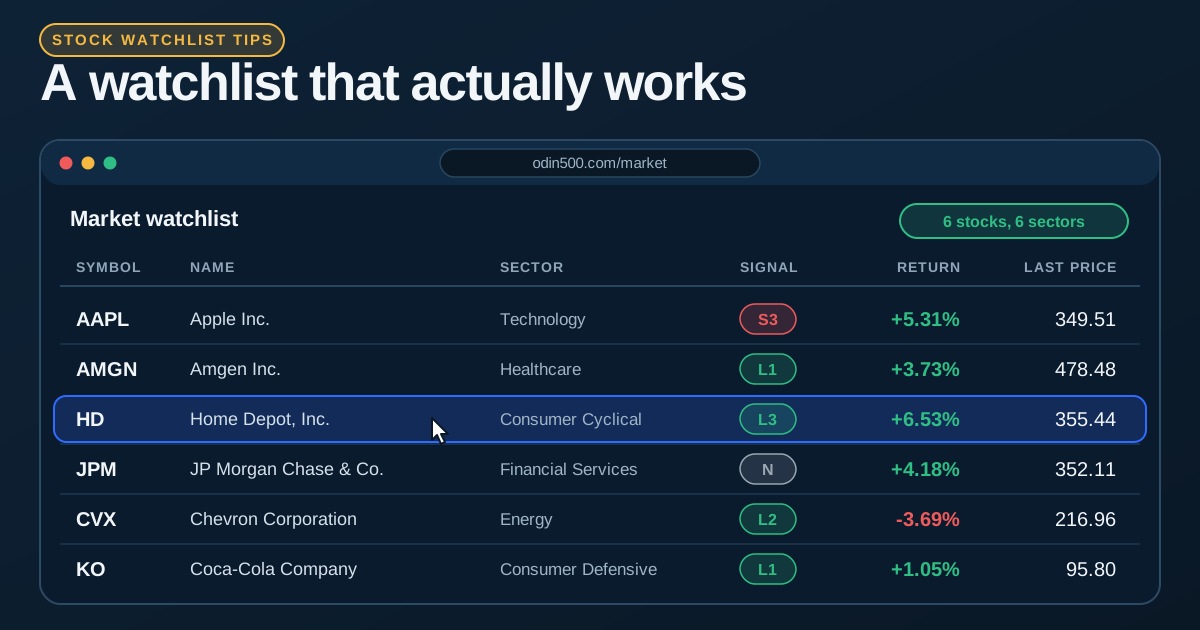
A signal or trend reading. Odin500's market watchlist snapshot shows an Odin signal next to each stock, along with its sector, return and last price, so you can scan a whole list in seconds.
Distance from your trigger. How far is the price from the level you wrote down?
6. Review on a schedule
Put ten minutes on the calendar each week. Ask three questions: Did any trigger hit? Did any reason stop being true? Which name hasn't earned its spot? Remove at least one stock whenever you add one. A list that only grows is a list nobody trusts. A weekly look at sector performance is a good way to start the review.
Mistakes to avoid
Building a wish list. If every stock is there because you like the company, you're collecting, not tracking.
Sorting by the biggest movers. Chasing whatever just went up is rarely a plan. The market movers page is good for discovering ideas, and our market movers guide shows how to use it, but those ideas belong on your Research list first.
Skipping the benchmark. Without SPY or a sector ETF on the list, you can't tell skill from luck.
Never pruning. Dead names add noise, and noise makes you miss the signal.
Putting it to work on Odin500
Odin500's market dashboard shows a market watchlist snapshot of the 30 Dow Jones stocks with each one's sector, Odin signal, return and last price. It also has normalized performance charts for comparing indexes and sectors. It's a good model for the columns your own list should carry.
Open any stock's ticker page for its OHLC chart and return summaries. If charts are new to you, start with how to read an OHLC chart. Use the heatmap to see which sectors are leading before you decide where to look, and our guide to reading a stock heatmap shows how. Once you have a trigger, test it risk-free in the virtual portfolio before you try it with real money. Our free tools for beginners explains how.
Key takeaways
Give every list one job: research, monitor or ready.
Keep each list short enough that you can explain every name in one sentence.
Cover several sectors and include benchmark ETFs so you can judge moves in context.
Write a reason and a trigger for each stock.
Review weekly, and remove a name whenever you add one.
Frequently asked questions
How many stocks should be on a watchlist?
There's no fixed number, but 10 to 20 per list is a practical range for most people. If you can't explain why each stock is there, the list is too long.
What should a stock watchlist include?
Each stock should have a reason for being there, a trigger that would make you act and a condition that would remove it. It's also helpful to include benchmark ETFs like SPY and a sector ETF for comparison.
How often should I update my watchlist?
A short weekly review works well for most investors. Check whether any triggers hit, whether any reasons changed, and which stocks no longer deserve a spot.
Should I watch the biggest daily movers?
Use them to find ideas, not as your list. Add interesting movers to a research list, learn why they moved and promote them only if the idea holds up.
What's the difference between a watchlist and a portfolio?
A watchlist tracks stocks you're interested in. A portfolio holds positions. Stocks often move from one to the other, which is why a Ready list is useful. A virtual portfolio lets you practice that step without real money.
This article is for educational purposes only and is not investment advice. Sector returns come from Odin500's market dashboard at the latest daily close at the time of writing and change every day.