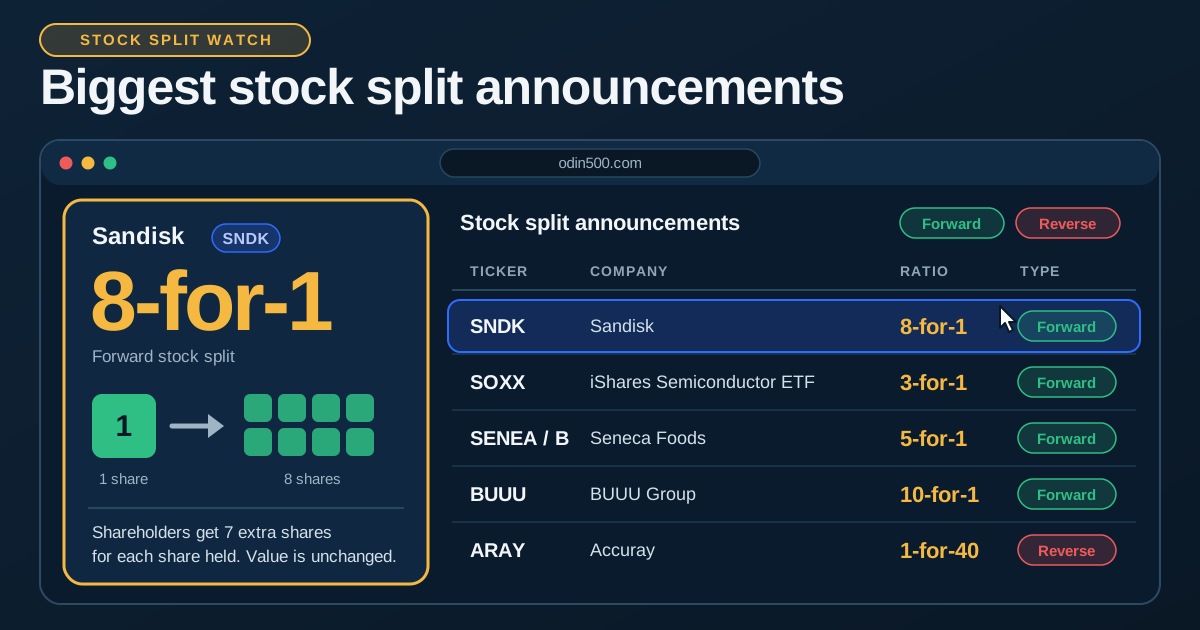
Stock splits are easy to misread. Share counts and prices change, and the headlines make it sound as if something big happened to the company itself. Here are the biggest recent and upcoming stock splits, with ratios, tickers and dates, and what each one means if you hold the stock.
Quick answer: Sandisk's 8-for-1 split is the biggest one still ahead, with split-adjusted trading expected on November 20. SOXX already split 3-for-1 on November 5, and Accuray's 1-for-40 reverse split took effect on November 9. A split changes the share count and the price per share, not what the company is worth.
The biggest stock split announcements
Status as of November 10, 2026.
Ticker | Company | Ratio | Type | Key date | What it means |
|---|---|---|---|---|---|
SNDK | Sandisk | 8-for-1 | Forward | Split-adjusted trading expected Nov 20 | 7 extra shares per share held |
SOXX | iShares Semiconductor ETF | 3-for-1 | Forward | Split-adjusted trading began Nov 5 | Share price fell to about a third |
SENEA / SENEB | Seneca Foods | 5-for-1 | Forward | Split-adjusted trading expected Nov 17 | Both share classes split |
BUUU | BUUU Group | 10-for-1 | Forward | Split-adjusted trading began Oct 26 | 10 new shares per share held |
ARAY | Accuray | 1-for-40 | Reverse | Effective Nov 9 | 40 old shares become 1 |
Sandisk: the headline split
Sandisk announced an 8-for-1 forward split on October 29, alongside its quarterly results. Shareholders of record at the close on November 9 receive seven additional shares for each share they own. The new shares are issued after the close on November 19, and split-adjusted trading is expected to begin at the open on November 20. You don't need to do anything. The company says the goal is to make the stock more accessible, including to employees through its stock purchase plan, and that market capitalization and ownership percentages won't change.
The split came with strong results. Quarterly revenue reached $11.0 billion, up 23% from the quarter before, and Sandisk spent $5.0 billion buying back about 3.2 million of its shares during the quarter. On announcement day the stock closed at $1,330.05, which works out to about $166 a share after the split. That was still about 43% below its June 25 record close of $2,335. Since then the shares have fallen further, to $835.06 at the November 6 close, or about $104 on a split-adjusted basis.
A simple example shows the math. A $1,200 share becomes eight shares worth about $150 each. Because the extra shares are issued after the close on November 19, stock sold between the record date and that day carries the right to the extra shares with it.
Other forward splits
iShares Semiconductor ETF (SOXX). The fund split 3-for-1, with split-adjusted trading starting on November 5. Its November 4 close of $450.41 became a $150.14 reference price. An ETF split changes the share price, not what the fund owns, and this fund last split 3-for-1 in March 2024.
Seneca Foods (SENEA and SENEB). Shareholders approved a 5-for-1 split on November 4, with about 2.19 million votes in favor and 16,296 against. The additional shares are expected to be distributed after the close on November 16, and split-adjusted trading should start on November 17. Both share classes split.
BUUU Group (BUUU). The Singapore-based company's board approved a 10-for-1 split on September 28 and announced it on October 16. Each share became ten, and split-adjusted trading began on October 26.
Reverse splits
Reverse splits do the opposite. Accuray's 1-for-40 reverse split took effect on November 9, so every 40 old shares became one. That cuts the share count from about 120.2 million to about 3.0 million. The company says the goal is to lift its price and regain compliance with Nasdaq's minimum bid requirement. In a 1-for-10 reverse split, 1,000 shares at $1 become 100 shares at $10.
Companies often use reverse splits to lift a price back above an exchange's minimum listing requirement. Unlike forward splits, which usually follow a rising price, a reverse split can be a warning sign.
What a split changes and what it doesn't
A split changes the share count, the price per share and the strike prices on options. For SOXX, an old $500 option strike became $166.67. A split doesn't change the company's value, your percentage ownership or the total value of your holding at the moment of the split.
It also isn't a reliable buy signal. One analysis of eight big-name splits since 2020 found that five were followed by a higher price a year later, with a median gain of about 26%. But the results ran from a 43% drop to a 79% gain. Six of the eight stocks closed within about 8% of their 52-week high on announcement day, and five of those six rose. Amazon and Netflix announced from well below their highs and did worst. Sandisk is splitting from far below its peak, so that history may not apply.
How to check a split before you trade
Confirm the ratio and type. Forward and reverse splits are very different events.
Read the company's announcement. It lists the record date, distribution date and when split-adjusted trading starts.
Check your chart data. Unadjusted history shows a fake crash on a forward split, so confirm prices are split-adjusted. Netflix's 10-for-1 split is a good example, and we explain it in how to read an OHLC chart.
Ask your broker about open orders and options. Brokers and exchanges handle limit orders, stop orders and option contracts around splits differently.
Check fractional shares. Sandisk won't issue any, and Accuray pays cash for fractions.
Following splits on Odin500
Odin500's ticker pages show OHLC charts and return summaries for U.S. stocks, such as AAPL. The market movers page shows which stocks are moving when news hits, and our market movers guide explains how to read it. The news page collects headlines.
Key takeaways
Sandisk's 8-for-1 split is the headline, alongside 3-for-1 on SOXX and 5-for-1 on Seneca Foods.
A forward split adds shares and lowers the price. A reverse split removes shares and raises it.
A split doesn't change what a company is worth. Treat it as a reason to research, not a reason to buy.
Frequently asked questions
What is the difference between a forward and a reverse stock split?
A forward split gives shareholders more shares at a lower price each, such as 8-for-1. A reverse split combines shares into fewer, higher-priced ones, such as 1-for-40. Total value is the same either way at the moment of the split.
Does a stock split make a stock a good buy?
Not by itself. A split changes the share price, not the company's value. Check earnings, growth and valuation the same way you would without a split.
When does Sandisk's stock split take effect?
Shareholders of record on November 9 receive seven additional shares for each share held. The shares are issued after the close on November 19, and split-adjusted trading is expected to begin on November 20.
Do I need to do anything when a stock splits?
Usually not. Brokers adjust positions automatically. Check that your open orders and options contracts were handled the way you expect.
This article is for educational purposes only and is not investment advice. Split terms come from company announcements, regulatory filings and news reports, and companies can change or cancel splits, so always confirm details with the company or your broker.